


Schiele’s New Dinosaur Hall Is Open Now — and a Great Reason to Visit Gastonia

3 hours ago
4 min read

Fall is a great time to explore, and there's something new to discover at the Schiele Museum of Natural History. The museum's new Elizabeth Williams Robinson Hall of Dinosaurs is now open, bringing visitors face-to-face with some of the largest and most fascinating creatures to ever walk the Earth.
This 4,200-square-foot hall isn't simply a collection of dinosaur displays. The animals, landscape, lighting and scenes flow together, creating the feeling that you've stepped into their world.

Step Back in Time
begin your journey in the River of Time.
The experience takes you backward through Earth's history, showing layers of the Earth and fossils from different eras. It helps put the dinosaurs into perspective: their world existed millions of years ago, after an incredible history of geological and biological change.
Some of the fossils you'll encounter are authentic. Others are remarkably accurate 3D-printed replicas created from scans of rare specimens. Schiele staff worked with fossil collectors and educational organizations to scan one-of-a-kind fossils, then transformed those scans into detailed replicas. The result is a more hands-on experience, allowing visitors to get close to and interact with specimens without putting irreplaceable fossils at risk.

Meet the East Coast T. rex
Appalachiosaurus
This dinosaur lived in what is now the eastern United States during the Late Cretaceous. Seeing this smaller relative before entering the main hall sets the stage for what comes next.
Because once you turn the corner, the scale changes dramatically.
It's Larger Than Life
The first thing that stands out inside the dinosaur hall is just how enormous it feels.
An enormous Apatosaurus stretches overhead, its long body wraps around the room.
The plant-eating dinosaur could reach roughly 69 to 75 feet in length, and its presence helps make the entire exhibit feel like one continuous environment rather than a collection of separate displays.
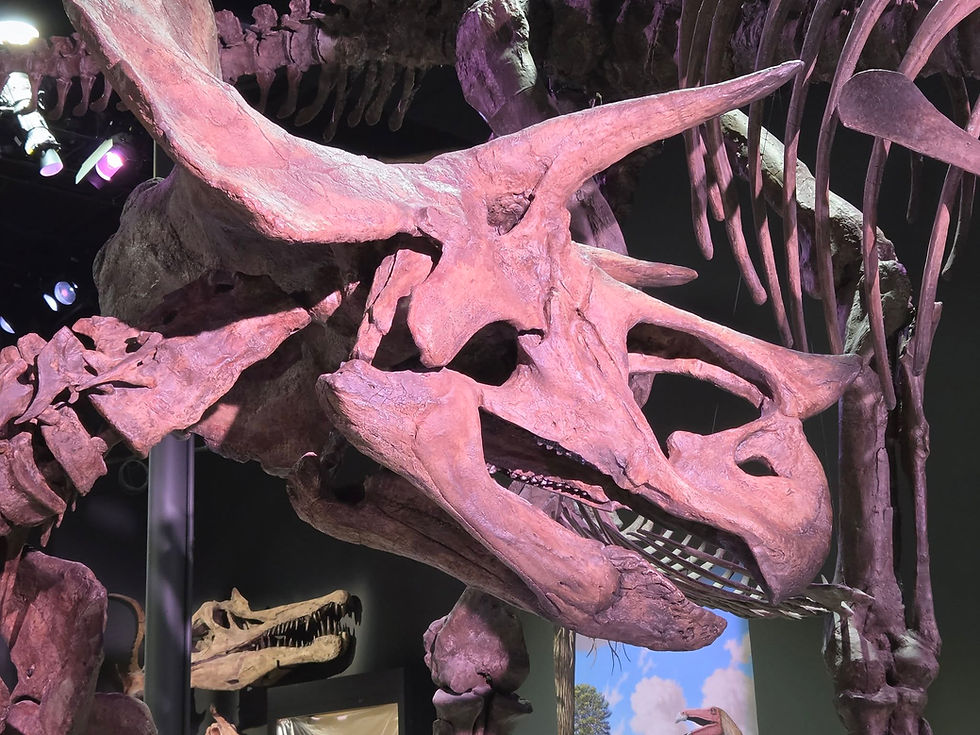
T. rex vs. Triceratops
one of the most dramatic scenes in the hall.
As you step into the room from beneath the Apatosaurus, you see the T. rex across the way. His head is lowered, his massive jaws open.
The position alone gives you a completely different sense of his size than seeing him standing in the entrance, where he had been for years.
A couple of steps closer and you realize he is just inches away from gulping down a baby Triceratops, about the size of a large dog by today’s standards.
At the same time, Mama Triceratops is charging in from the side, ready to T-bone the T. rex, who is completely unaware of what’s coming.
You’re standing right there in the middle of the action, close enough to look into the predator’s eyes. And you can’t help but wonder what is going to happen in the next few seconds—and who would win.
That’s what makes this exhibit so different. You’re not simply looking at dinosaurs. You’re surrounded by them. You’re immersed in them.
And there’s more to discover as you look around the room.
A Stegosaurus stands on its hind legs, using its powerful tail for support as it reaches into a tree to feed.
The massive Apatosaurus seems to stretch around the room, while changing lights move the environment from dawn to dusk, making the prehistoric world feel alive.
Monty, the Dinosaur Mummy
One of the exhibit's most prized specimens: Monty, a real Edmontosaurus fossil.
Monty is a dinosaur mummy, with preserved skin impressions along the tail. Look closely and you'll also see evidence of multiple T. rex bites. Even more remarkable, Monty's bones show signs that he survived those attacks and that the injuries healed.
It's a remarkable glimpse into the life of an individual dinosaur—not just what it looked like, but what it experienced millions of years ago.

Designed for Kids to Discover
The Schiele makes learning something you can experience.
Children can get close to the specimens, explore hands-on experiences and engage with the science behind what they're seeing. A dinosaur puppet adds another playful way for young visitors to connect with the subject.
And the dinosaur hall is just one part of the museum.

Plan To Spend Some Time At The Schiele
Once you've explored the dinosaurs, there's plenty more to see.
Visit Dino Safari, where prehistoric fun continues in another experience. Explore Cats Untamed, visit the farm, take in a show at the Planetarium, or head outside onto the Nature Trail.
There are enough different experiences at the Schiele that you can easily turn a visit to the new dinosaur hall into a full day of discovery.

See Gastonia In Gastonia
Before you even reach the dinosaur hall, you’ll see Gastonia on display. This heavily armored, plant-eating dinosaur lived during the Early Cretaceous, about 142 to 127 million years ago.
And when you leave, you’ll pass it again.
That makes it a pretty fun reminder: you’re in Gastonia—now get out and explore it. Spend some time downtown, find a local restaurant or shop, check out the arts and culture, and then venture beyond the city to discover more of Gaston County.
Come For The Dinosaurs. Stay For Fall.
The new dinosaur hall is open now, and fall is a great time to experience it.
Come to the Schiele and travel backward through time. Walk beneath an Apatosaurus. Look into the eyes of a T. rex. Watch Mama Triceratops charge into the action. Find Monty. Say hello to Spike. Then keep exploring everything else the museum has to offer.

Schiele’s New Dinosaur Hall Is Open Now
Cooler fall temperatures are perfect for getting outside, following the Dino Trail, searching for fall color on a hike, visiting a local farm, grabbing a pumpkin latte, exploring one of Gaston County's downtowns or checking out a fall festival or other seasonal experience.
There's plenty to see and do this fall in Gaston County.
Schiele’s New Dinosaur Hall Is Open Now Come see them—and make a weekend of it.
Plan Your Visit
Schiele Museum of Natural History
1500 E. Garrison Blvd., Gastonia
Hours:
Monday–Friday: 10 a.m.–4 p.m.
Saturday: 10 a.m.–5 p.m.
Sunday: 1–5 p.m.


